Excursion to the Tautenburg Observatory
Still a bit sleepy, but no less motivated for it, we kicked off our first event—an excursion to the Thuringian State Observatory in Tautenburg—during the 25/26 winter semester, right on time at 8:00 a.m. at Leipzig Central Station. The challenge ahead of us was no small feat: Given the chosen route—with four segments, three modes of transportation, and transfer times as short as five minutes in some cases—arriving on time was nearly impossible. Perhaps it was due to the positive atmosphere the participants brought with them and the lively conversations, but in any case, we reached our destination on time despite these challenges. After a short walk from the bus stop to the observatory, we were warmly welcomed by our guide, Dr. Eike Günther, and—without further ado (we had to start our return journey just two hours later)—led into a seminar room. In his lecture, Dr. Günther gave us an insight into the exciting field of exoplanet research—that is, the study of planets outside our solar system. In particular, he focused on the search for (Earth-like) planets that could support life. His account of the history of the universe also left a particularly lasting impression: If you scale the approximately 13.8 billion years since the Big Bang down to a calendar year, multicellular life didn’t emerge until early December, and the entire history of humanity (defined by the beginning of agriculture and livestock farming) falls in the last minute of the year.
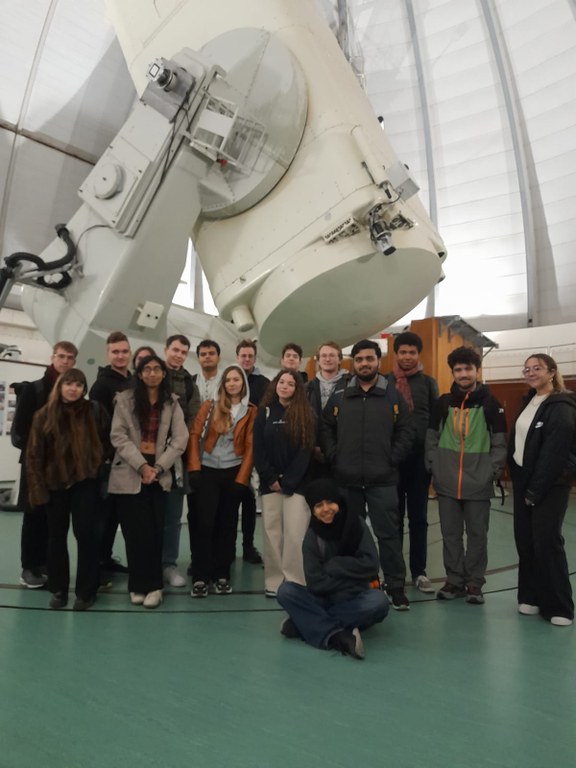
View of the Alfred Jensch telescope (© DPG / Frederking 2025)
After the lecture, we were able to view the Alfred Jensch Telescope up close—a true highlight of the excursion. Both the telescope’s size and its age were particularly impressive. After the construction phase, led by its namesake, engineer Alfred Jensch, the telescope was first put into operation in 1960. As Dr. Günther explained to us, it’s not uncommon for telescopes to be used for such a long time, since the key components can be repeatedly upgraded to reflect the latest technological advancements. While today the tracking is fully automated and images are generated with the click of a mouse, when observations first began at the observatory, expensive photographic plates were still used, and images were captured much less frequently. Even back then, it was already clear for some observations that the full value of the records would only become apparent to future generations. Thanks to the work of earlier generations of scientists, long time series of observations are now available in the observatory’s library.
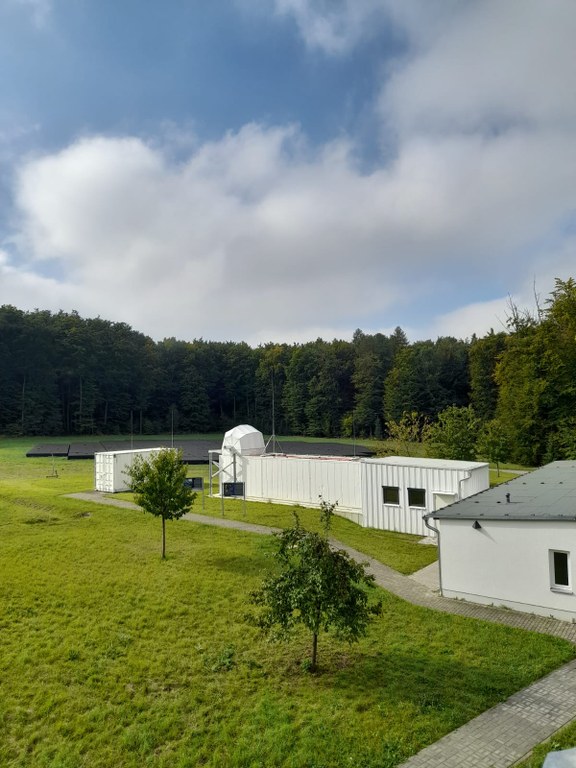
View of the radio telescope and the solar laboratory (© DPG / Frederking 2025)
Our visit to the observatory concluded with a view of the observatory’s radio telescope and the Tautenburg Solar Laboratory. This is a fine example of potential applications that stem from basic research in astrophysics and have implications for everyday processes on Earth. As Dr. Günther explained to us, the instruments at the Solar Laboratory could, in the future, help predict solar storms, the effects of which are relevant to aviation.
Unfortunately, we were unable to walk the “Planet Trail,” which features information panels spaced at true-to-scale distances from one another, detailing the celestial bodies of our solar system. We thank Dr. Günther for the informative tour and wish all participants a great start to the fall!