Exciting nanostructures: Characterizing advanced confined systems
Bad Honnef Physics School
- Datum:
- So, 11.07.2027 18:30 – Fr, 16.07.2027 14:00
- Sprecher:
- Christian Klinke (Rostock and Swansea ) and Beatriz H. Juárez (Madrid)
- Adresse:
- Physikzentrum Bad Honnef
Hauptstr. 5, Hauptstr. 5, 53604 Bad Honnef, Germany
- Sprache:
- Englisch
- Kontaktperson:
- Dr. Victor Gomer (Physikzentrum Bad Honnef),

Beschreibung
Scientific organizers:
Prof. Dr. Christian Klinke (University of Rostock and Swansea University) and
Prof. Dr. Beatriz H. Juárez (Institute of Materials Science of Madrid)
July 11 - 16, 2027, Physikzentrum Bad Honnef, Germany
supported by

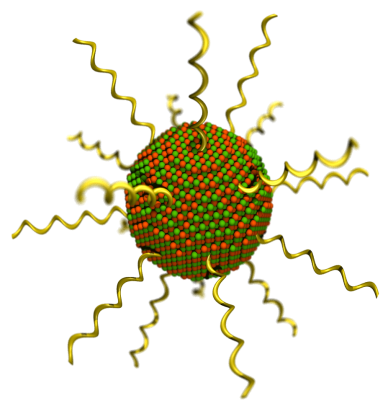
The developments in our society in terms of computing power, sensing, and alternative energy demand new generations of building blocks for future optical and electrical applications with higher efficiencies and lower costs. In the recent years, enormous progress has been made in defining nanostructures and in understanding their physical properties. Nowadays, it is possible not only to prepare spherical, zero-dimensional nanoparticles, but also one-dimensional nanorods, two-dimensional nanosheets and hybrid materials. Structural design aims on developing of sophisticated core-shell and Janus nanoparticles, doped materials, and materials with specifically modified surfaces. Shape and structure have a strong influence on their physical properties, which results mainly from their large surface-to-volume ratio and/or from the quantum confinement of their electrons and holes – but also plasmonic effects play a big role. The nanoobjects of various shapes can be further utilized as building blocks for even more sophisticated 2D or 3D assemblies.
The development of such materials has led to a broad range and ever-increasing number of electronic applications amongst which are LEDs both for lighting and for displays, batteries and capacitors, highly selective catalysts and electrocatalysts, sensors and photodetectors, and many more. Nanostructured materials such as nanoparticles, nanowires, carbon nanotubes, and graphene are among the most promising candidates for faster and less expensive electronic devices and more efficient solar cells and fuel cells. This is mostly due to their low-dimensional nature which opens new intriguing possibilities for technology. Thin films of semiconductor nanoparticles can be used as inexpensive transistors, photodetectors, chemical sensors, and as solar cells. Moreover, all these semiconductor devices can be literally printed by using colloidal suspensions of nanocrystals as inks. Nanoparticles which show super-paramagnetic behavior should find their way into hyperthermia therapy and contrast enhancer in nuclear magnetic resonance imaging.
Scientifically, low-dimensional objects also represent exceptionally interesting model systems, which allow the extension of classical and the development of alternative concepts on a new field of physics with ground-breaking insights. Examples are single-electron transistors, Coulomb blockade, ballistic transport over micrometers in length, and continuously tunable optical properties. Emerging new topics in this field are topological insulators, semiconductors with giant oscillator strength, and spin transport. To produce nanomaterials with new, tailored properties it is indispensable to understand the synthesis mechanisms in detail.
In this summer school the basics of the preparation of nanostructures, the resulting physical properties, their optoelectronic applications, and theoretical methods will be reviewed. Beyond, the topics machine learning, energy harvesting, and applications in medicine will be discussed as well. The summer school provides an ideal forum for Master and PhD students to become acquainted with the field and to initiate further discussions. The participants are expected to present their own work in the form of posters and are given the chance to introduce it also in the form of flash presentations.
More information coming soon...
FEES: 200 € full board and lodging (for DPG* members 100 € )
* The German Physical Society (DPG)
Attention: There are some fake companies, which pretend to organize your stay in Bad Honnef. Please, be careful and do not reply to them. Your accommodation and full board will be provided exclusively by the Physikzentrum.