
Joint Call of the Deutsche Meteorologische Gesellschaft and the Deutsche Physikalische Gesellschaft
Introduction
The effects of human-induced climate change are now obvious and their magnitude threatens to exceed our adaptive capacities. Moreover, there are increasing signs that global warming is advancing faster than previously expected. Urgent action is therefore imperative. Extreme weather events in Germany, Europe and around the world are increasing in both intensity and frequency, and increasingly occurring in regions in which they were previously unknown. The combination of heat and dry conditions causes forests to die off and is very detrimental to agriculture. The local water balance is also very adversely affected by the consequences of global warming (melting of glaciers in the Alps, the absence of snowmelt, etc.). This has an impact on agriculture and also on the drinking water supply. Hurricanes are now ravaging regions that were largely unaffected by them in the past and are not prepared for them. Extreme weather events, including widespread flooding and large-scale forest fires, are claiming vast numbers of lives, and causing damage to private and public infrastructure running into many billions of euros every year. Temperatures are reaching record levels in many regions on Earth. These heatwaves represent a serious health hazard – even in Germany. They particularly endanger older people and those whose health is impaired. Rising temperatures diminish the population’s ability to work and thus cause enormous economic damage. Simultaneously, experts are observing a drastic loss of biodiversity worldwide, which is further exacerbated by climate change and adversely affects the resilience of our ecosystems. All over the world, there is a growing risk that poverty, hunger, forced migration, and societal and global instability will increase further.
Despite these obvious developments, the response of the global community and Germany as well to the dangers associated with global warming has so far been inadequate at most.
Starting Point
Annual emissions of CO2 have increased by 60 percent since the Deutsche Physikalische Gesellschaft (German Physical Society, DPG) and the Deutsche Meteorologische Gesellschaft (German Meteorological Society, DMG) issued their warning about climate change in 1987 [0], and the first report of the UN’s Intergovernmental Panel on Climate Change (IPCC) in 1990. Half of the CO2 emitted since the start of the industrialisation 150 years ago has been emitted during the past 30 years. The concentrations of other climate-relevant trace gases in the air such as methane, nitrous oxide and halogenated hydrocarbons are also increasing drastically around the globe.
If this trend continues, physics alone will cause the mean near-surface temperature to rise further. Amplifying feedback effects and so-called tipping points possibly associated therewith are accelerating this warming even more.
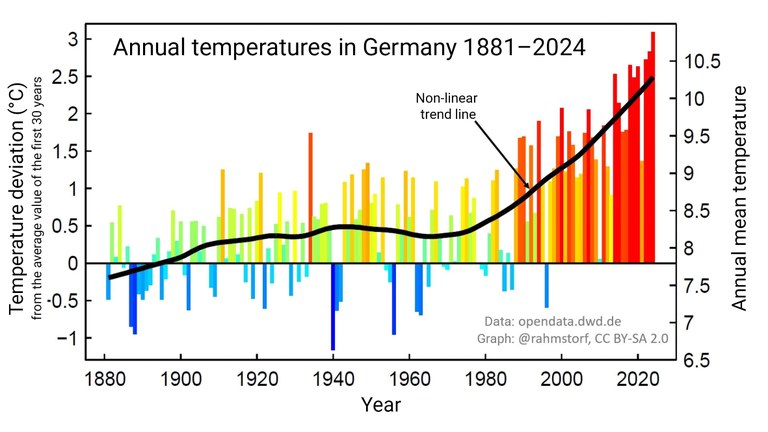
Annual temperatures in Germany 1881–2024 A significant increase in temperature over time can be seen. © Stefan Rahmstorf; Data source: Deutscher Wetterdienst, CC BY-SA 2.0
Measurements show that the warming exhibits regional and seasonal differences. Basically, it is more pronounced above the continents than above the oceans. The Arctic is heating up the most. And whereas here the warming is causing the polar ice to melt, in Central Europe and the Mediterranean in particular it is leading to increasing numbers of heatwaves, droughts and forest fires, as well as torrential rain and flooding. In 2023/2024, the global annual mean temperatures exceeded the mean of the pre-industrial era by 1.5 degrees Centigrade for the first time. Physical relationships make it possible to conclude that the 1.5-degree limit of the Paris Agreement may already have been exceeded. However, this can be determined only in retrospect in a few years, when it is already too late to take countermeasures.
Causes of the increase in climate-relevant trace gases in the atmosphere:
Carbon dioxide (CO2): mainly through the burning of coal, oil and natural gas, as well as industrial processes (such as cement production), deforestation, soil erosion and the drainage of wetlands.
Methane (CH4): through agricultural intensification, especially livestock breeding and rice cultivation, the utilisation of plant- and animal-based raw materials, leaks in natural gas infrastructures (particularly with fracking), changes in tropical wetlands, and the thawing of permafrost soils as a consequence of global warming.
Nitrous oxide (N2O): through microbial metabolism especially in agriculture, the excessive use of fertilisers, and the cultivation of plants to produce biofuels.
Halogenated hydrocarbons: through improper disposal or leaks from cooling & air conditioning equipment and certain types of heat pumps, and also through industrial processes.
Although these gases allow the visible solar radiation to reach Earth almost unhindered, they do absorb some of the thermal radiation which Earth then produces and prevent it escaping into space (greenhouse effect).
Outlooks
Although greenhouse gas emissions in Germany have been reduced since 1990, the current measures are not sufficient to achieve the goals of the German Federal Climate Action Act by 2030 or greenhouse gas neutrality by 2045 at the latest. In Germany and on the international stage, the climate change mitigation goals which have been pledged are far too low (ambition gap), and the measures which are currently being implemented and planned are not sufficient to achieve even these inadequate goals (realisation gap). This has far-reaching consequences: There is a strong probability that the ambition gap will lead to a temperature rise of 2 to 5 degrees Centigrade compared to pre-industrial temperatures by 2100, the realisation gap to a further rise of several degrees Centigrade.[1,2,VI] There is a danger that the mean temperature will already have risen by 3 degrees Centigrade by 2050.
![The moderate climate of the last ten thousand years created the conditions for the evolution of human civilisations. The current generation of young people needs to be aware of the fact that it will possibly experience the end of these moderate environmental conditions with all associated consequences. © DPG / Gehlen 2025 [IV]](https://www.dpg-physik.de/veroeffentlichungen/publikationen/stellungnahmen-der-dpg/klima-energie/klimaaufruf/stellungnahme_de-en/2026-01-13-dpg_klimaaufruf_2025_abbildung_englische_version.jpg/@@images/d88882bc-4573-4181-b712-06eaf2e67cde.jpeg "The moderate climate of the last ten thousand years created the conditions for the evolution of human civilisations. The current generation of young people needs to be aware of the fact that it will possibly experience the end of these moderate environmental conditions with all associated consequences. © DPG / Gehlen 2025 [IV]")
The moderate climate of the last ten thousand years created the conditions for the evolution of human civilisations. The current generation of young people needs to be aware of the fact that it will possibly experience the end of these moderate environmental conditions with all associated consequences. © DPG / Gehlen 2025 [IV]
The Paris Agreement laid down a maximum permissible global warming of well below 2 degrees Centigrade, ideally 1.5 degrees Centigrade, as the long-term goal. This means that an upper limit for CO2 emissions which can still be emitted (global remaining CO2 budget) must be kept to. In relation to limiting global warming to 1.5 degrees Centigrade, a fair portion of this budget for Germany had probably already been used up by 2023.[3]
To keep to the limit agreed in Paris under the legally binding international treaty on climate change, the CO2 emissions must be significantly reduced as of now and even more in the coming years. For the other goal stated in the Paris Agreement, to limit global warming to well below 2 degrees Centigrade (climate threshold), and thus avoid an uncontrollable further development, the main priority will also be to greatly reduce the CO2 emissions as rapidly as possible around the globe. Back in 2021, the IPCC already spoke of halving CO2 emissions by 2030 compared to the level in 2019 while at the same time removing CO2 from the atmosphere in order to adhere to the 1.5 degrees Centigrade.[4] The ruling of the German Federal Constitutional Court of 24 March 2021 creates an obligation that political decisions in Germany must aim to limit the global mean temperature rise to well below 2 degrees Centigrade and ideally 1.5 degrees Centigrade compared to the pre-industrial level. The fact that greenhouse gas emissions must be reduced and climate neutrality achieved by 2045 also follows from the German constitution.[5,6] The viewpoint of the DPG and the DMG is that curbing the ever-increasing global warming with its foreseeable risks to health and human life requires there to be a consistent and overriding focus on reaching the global CO2 net zero emissions by the middle of the century. In the long term, the atmospheric concentration of greenhouse gases and CO2 in particular must then be reduced even further by natural methods or technical measures. Technical methods are not yet available to a sufficient extent, are de facto unaffordable to the extent needed, and require vast amounts of energy to be effective.
Scientific Background
Natural greenhouse effect
Water vapour and carbon dioxide (CO2) in the atmosphere have a crucial impact on the climate. The trace gases absorb some of the heat radiated by Earth’s surface and reflect some of it back. This greenhouse effect means the average temperature on Earth's surface is currently around +15°C (+59°F). Without these greenhouse gases, the average temperature on Earth's surface would be around -18°C (-0.4°F). Over the past few million years, Earth’s mean temperature when averaged over many years varied in relation to the pre-industrial average by approx. -5°C to +2°C (23°F to 35.6°F) between ice ages and warm periods. The variations since the end of the last ice age around 10,000 years ago were way below +/-1.5 degrees Centigrade.[7]
Global carbon footprint
From the beginnings of industrialisation around 1750 AD to September 2024, the CO2 concentration in the atmosphere increased by about 50 percent overall. Compared to 2023, the further increase amounted to around one percent within one year. In 2023, the main sources of the CO2 emissions were the burning of fossil fuels such as coal, oil and natural gas (37 gigatonnes of CO2), as well as changes to land utilisation. Added to this is the destruction of parts of the biosphere, particularly through forest fires, deforestation, soil erosion and draining of wetlands (4 gigatonnes of CO2). Only around 43 percent of the carbon dioxide released during the past 175 years has remained in the atmosphere. Most of the remaining 57 percent has so far been stored in the oceans (26 percent) and in the terrestrial biosphere (31 percent).[8] In 2024, the increase in the CO2 concentration amounted to more than 3.5 ppm (parts per million). This is by far the largest annual increase since direct CO2 measurements began [9], which points to a reduction in the absorption capacity of the biosphere due to climate change. If the CO2 concentration doubles compared to the pre-industrial level, the global mean temperature will rise by around 2 to 5 degrees Centigrade.[10, VII] Current analyses of ocean sediments and satellite measurements in relation to the change in the ability of Earth’s surface to reflect sunlight, its so-called albedo, indicate that the upper value is more likely.[11, VIII] In this case, the remaining budget of CO2 emissions would be much smaller than previously calculated, and CO2-net-zero (climate neutrality) would have to be achieved much earlier than previously assumed.
Other important greenhouse gases
The CO2 emissions produced by human activity are not the sole cause of global warming. Other important climate-relevant trace gases are:
- Methane (CH4), the main constituent of natural gas, has a global warming potential which is around 28 times higher than that of CO2 over a 100-year period.[12] Methane escapes in large quantities during the extraction of oil, as well as during fracking and the transport of natural gas. In addition, it is produced naturally in the environment through the anaerobic (in the absence of air) decomposition of biomass by bacteria, for example in wetlands, in farming (particularly during digestion in ruminants), in wastewaters and in waste disposal sites. Moreover, the advance in global warming could also cause large quantities of the methane trapped in the permafrost to enter the atmosphere in the future.[13]
- Nitrous oxide (N2O), also known as laughing gas, has a global warming potential which is around 273-times higher than that of CO2 over a 100-year period.[13] It is produced during the microbial decomposition of surplus nitrogen fertilisers and in combustion processes, amongst other things. Nitrogen fertilisers must therefore be used in moderation and plants for biofuels should not be cultivated. [14]
- Halogenated compounds (HCFCs), which are now increasingly being used to replace the previously used chlorofluorocarbons (CFCs), have a global warming potential which is 800- to 7,000-times higher than that of CO2.[13] They have the highest rates of increase of all greenhouse gases.[15] Their use should be restricted more rigorously than is so far regulated by the European Union (EU). For heat pumps and air conditioning systems in particular, it is important that gases with a low global warming potential, such as propane, are used.[16]
Predictions
The increase in the atmospheric concentration of greenhouse gases has led to an increase in the mean near-surface temperature on Earth of around 1.1 degrees Centigrade (average 2011-2020) and 1.5 degrees Centigrade in the years 2023 and 2024 compared to the pre-industrial reference period (1850-1900). Current climate model computations predict the following, highly probable consequences for the global mean temperature on Earth’s surface:
- If the CO2 concentration doubles compared to the pre-industrial level, the temperature will increase by around 2 to 5 degrees Centigrade [10], there currently being many indications that the higher value is more realistic.[11] A possible cause for this is the global reduction in sulphur emissions, which in the past played a role in reflecting more of the incident sunlight. It could also be down to a significant change in cloudiness, however, which is triggered by global warming itself.[17] Simultaneously, the increased warming in recent years was masked by a long La Niña phase in the Pacific Ocean, and only became apparent afterwards through the subsequent El Niño phase.[18]
- If all effects and feedback mechanisms are considered, the warming could be even greater. There may also be regional variations, for example the warming in the Arctic is still expected to be much greater than the warming near the equator.[19]
- The fact that the near-surface layer (air temperature) above terrestrial surfaces heats up more strongly than above marine surfaces is down to physics. This means that temperature increases in Germany as well are higher than the global average.[20] In 2024, Germany was already around 3.1 degrees Centigrade warmer than when systematic weather records began (1881–1910).[21] Regional climate models show that a further temperature increase of between 4 and 6 degrees Centigrade is to be expected by the end of the century for the “business-as-usual” emissions scenario (compared to 1881–1910).[22]
Feedback effects
Earth’s climate is determined by a great many amplifying and mitigating feedback mechanisms. Three amplifying and physically understandable feedback mechanisms are listed below by way of example:
- The thawing of permafrost soils leads to the decomposition of large quantities of previously frozen ancient organic matter and thus the emission of methane and CO2. The global warming potential of these two gases then in turn increases the global temperature and accelerates the thawing further.
- The melting of the sea ice and the polar ice sheets, as well as the melting of the glaciers in high mountain regions, amplifies the absorption of the incoming solar radiation. This leads to a local temperature increase, which in turn accelerates the melting. When these local processes cover large areas, this also has a global impact. The so-called Arctic amplification can have far-reaching consequences for the weather in Central Europe, since the temperature difference between the polar regions and the tropics plays a crucial role in controlling the atmospheric circulation and thus the weather.
- The warming of the upper oceanic layers creates more stable layers which slow down the vertical circulation and thus lead to a further rise in the surface temperatures of the oceans. The energy take-up from the atmosphere is thus reduced, causing the global air temperatures to rise even further.
In addition, the increasing CO2 concentration causes the stratosphere to cool, which in conjunction with the still active CFCs depletes the ozone above the Antarctic and the Arctic. Changes to the global air circulation caused by global warming amplify this process, as happened in spring 2020 (Arctic ozone hole).[23,24] This increases the UV irradiance at middle and higher latitudes [25], which has negative consequences for human health. Moreover, an ozone hole over the Arctic amplifies atmospheric blocking, leading to warm, dry weather conditions over Southern Europe and moist conditions over Northern Europe, among other things. [26]
These feedback effects show what the consequences of the continuous increase in greenhouse gas concentrations can be. Furthermore, there is a danger that successes, such as preventing ozone depletion by banning CFCs, are significantly delayed, if not completely negated, by these feedbacks.
Dangers of accelerating global warming
These predicted climatic changes are no longer a scenario for a distant future – they are happening in the here and now. In 2023 and 2024, a large number of key climate change indicators reached levels which far exceed those of the natural climatic variations of recent millennia. This was the case with the global mean Surface air temperature, the global mean ocean surface temperature, the temperature of the North Atlantic, and the retreat of the Antarctic sea ice by an area 7-times the size of Germany, for example.
At the same time, there were devastating, long-duration heatwaves, heavy precipitation events, and flooding such as that in the Ahr valley in Germany, in Greece, Libya, and 2024 in South-Eastern Europe, as well as huge forest fires such as those in Canada, Australia and Siberia. This sharp increase in large-scale extreme weather events in recent years is reason to fear that the high greenhouse gas concentrations are causing a fundamental change in the climate system, and this change continues to accelerate. Whether anthropogenic climate change could lead to worldwide societal collapse [27, 28] is rarely the topic of research and public debate at present.
Tipping points
In the future, climate tipping points – threshold values in the climate system which lead to irreversible changes when exceeded – could play an important role. The parts of the climate system and the ecosystem concerned are termed tipping elements. They are, for example: the weakening of the North Atlantic circulation (“Gulf Stream”), the melting of the ice sheets on Greenland and in Antarctica, the increasing release of enormous quantities of methane from the permafrost regions, and the large-scale dieback of the Amazonian rain forest.
Even though such changes are possible in principle, it is difficult to estimate when they will occur and the likelihood they will occur. Even a low likelihood would already be sufficient reason to act immediately, since the consequences of these events occurring are serious. But even if the tipping points in the climate system are not exceeded, the effects of a continued emission of greenhouse gases are dramatic.
Why climate change differs from other environmental problems
While it was possible to solve many earlier environmental problems, such as acid rain in the 1980s and 1990s, through stricter regulations on air quality management, it is not so easy with climate change. Carbon dioxide accumulates in the atmosphere, the ground and the oceans, and remains there for periods ranging from tens to thousands of years. Even if the global CO2 emissions were stopped immediately, the warming already caused by the emissions would remain for generations.[29] A “carbon debt” can therefore be assigned to anthropogenic climate change. From a historical point of view, Western industrial countries in particular, including Germany, are already under a debt to actively remove carbon from the atmosphere.
Negative greenhouse gas emissions
Practically all current scenarios [19] which allow the warming to be held below 2 degrees Centigrade require significant amounts of CO2 to be removed; this is known as Carbon Dioxide Removal (CDR), or also negative greenhouse gas emissions. This includes in particular the natural and long-term storage of organic carbon compounds from biomass, e. g. by building up humus, renaturation and rehydration of wetlands, afforestation of forests and vegetation in desert borderlands, and the pyrolysis and subsequent storage of the charcoal produced. Simultaneously, carbon-binding ecosystems must be protected and more effort must be directed towards further developing biogenic building materials (wood, fibre composite materials, insulating boards, etc.) and making greater use of them in construction.
Other measures such as filtering CO2 out of the atmosphere including its storage and utilisation (Carbon dioxide Capture and Storage – CCS, Carbon Capture and Usage – CCU) require more energy and more technical infrastructure for the retrieval, liquefaction, transport, injection and the subsequent processing of the CO2 than the biological route. Methods which do not bind CO2 in the long term, such as deep injection into boreholes during the extraction of oil and natural gas, do not count as CDR measures.[30] CCU serves to cover the industrial need for carbon without having to resort to fossil fuel-based sources in a CO2-neutral circular economy. It is currently not possible to estimate whether methods such as the direct removal of CO2 from the air (Direct Air Capture CCS – DACCS) can be provided to a sufficient extent. To be of relevance in mitigating climate change, these technologies would have to be scaled up to several tens of gigatonnes of CO2 per year, and every year suitable storage sites with similar capacities would have to be developed. There is no telling whether future generations will get to grips with this task in the upcoming decades with novel, industrial solutions.[I]
Similar considerations apply to other approaches to geo-engineering such as so-called Solar Radiation Management, whereby solar radiation is reduced by releasing aerosols into the atmosphere, for example. These methods can often not be scaled up to capacities suitable for climate change mitigation or they have direct, harmful effects on the environment. Other geo-engineering methods have as yet unforeseeable consequences for the global weather and global ecosystems, as well as agricultural production, accompanied by a massive potential for conflict between various players. Thus, as a matter of principle, geo-engineering measures should not be taken when their consequences are unforeseeable.
To limit global warming, it is imperative that there is further research and development in relation to CDR and how to transfer the results into practical applications before such technologies are implemented on a large scale and subsidised with public money. CDR is not an alternative to reducing greenhouse gas emissions, however.[30]
Consequences of the fossil fuel era – costs and health risks
Depending on the extent to which global warming progresses, it is estimated that the climate change-induced economic damage in Germany will already have totalled up to EUR 900 billion by 2050.[31] Even with appropriate adaptation measures, the expected damage due to strong global warming can only be partially avoided. Furthermore, there are limits to adaptation, and these limits will already be reached when the warming exceeds 1.5 degrees Centigrade, according to the IPCC.[32] In a world which is 3 degrees Centigrade warmer, the number of heat-related cases of illness and death in Europe will be even much higher than today and stretch the health care systems to their limits.[33] Even now, heatwaves are already having fatal consequences for the elderly, the sick and pregnant women. A meta-study [34] published in The Lancet journal in October 2024 underlines this with the following observations:
- In 2023, the global number of heat-related deaths among the over-65s was roughly 167 percent above the level of the 1990s. One would have expected that demographic changes alone, i. e. the ageing world population, would cause the number of heat-related deaths to increase by only 65 percent.
- In 2023, people all over the world were exposed to health-threatening temperatures for 50 days more on average than would have been expected without global warming.
- Heat is increasingly affecting physical activity and the quality of sleep; heat stress led to six percent more sleepless hours (global average) in 2023.
- The human population has experienced an increase in extreme precipitation and dry conditions on more than half of Earth’s land mass.
- Changes in precipitation and higher temperatures favour infectious diseases such as dengue fever, malaria, West-Nile virus and vibriosis.
- Between 2019 and 2023, extreme weather events caused economic damage amounting to more than EUR 200 billion worldwide, which corresponds to an increase of 23 percent compared to the period 2010 to 2014.
- In addition, heat stress led to a loss of 512 billion hours of work worldwide, worth around EUR 800 billion.
- As early as this year, tropical regions may for the first time experience combinations of moisture and heat whereby people can no longer survive in the open because the body’s own cooling system fails and condensation occurs in the lungs.
A further consequence of global warming which is already evident today are the growing numbers of people who have to leave their homes because of extreme weather events such as droughts, flooding and the decline in biodiversity. Forecasts show that food production could decrease by between 6 and 14 percent by 2050, and thus a further 556 million to 1.36 billion people could suffer “severe nutrition insecurity”.[35] The expansion of areas made uninhabitable by extreme heat is estimated to affect 1 to 3 billion people by 2070.[36,37] In addition, around one billion people will be directly affected by the expected rise in sea level by the middle of the century and may possibly have to move from their current homes as a result.[38]
![The graph shows the global mean sea level rise in metres over the coming decades for various SSP (Shared Socioeconomic Pathway) scenarios. The lines represent the mean value and the coloured area indicates a 66% probability region. Graph adapted from the NASA Sea Level Projection Tool [III] © DPG / Gehlen](https://www.dpg-physik.de/veroeffentlichungen/publikationen/stellungnahmen-der-dpg/klima-energie/klimaaufruf/stellungnahme_de-en/dpg_klimaaufruf_2025_diagramme_layout_ssp.png/@@images/5844ce01-add4-4648-9bd5-c9506b059faf.png "The graph shows the global mean sea level rise in metres over the coming decades for various SSP (Shared Socioeconomic Pathway) scenarios. The lines represent the mean value and the coloured area indicates a 66% probability region. Graph adapted from the NASA Sea Level Projection Tool [III] © DPG / Gehlen")
The graph shows the global mean sea level rise in metres over the coming decades for various SSP (Shared Socioeconomic Pathway) scenarios. The lines represent the mean value and the coloured area indicates a 66% probability region.
SSP1-2.6 - the 2-degree limit agreed in Paris will probably be kept to. This assumes there will be ambitious climate change mitigation and significant negative emissions towards the end of the century. SSP2-4.5 - Scenario where all countries meet their declared climate change mitigation goals, warming is around 2.7 degrees Centigrade on average. SSP5-8.5 - “business-as-usual” scenario, worst-case scenario for climate change mitigation. In these 3 scenarios, the sea level rise is estimated by means of many different climate models.
The SSP5-8.5 “Low Confidence” scenario includes – under the SSP5-8.5 emission scenario – processes which have not yet been researched sufficiently (instabilities in the ice in Antarctica and Greenland could significantly accelerate the sea level rise[II]). Most climate models do not yet take these processes into account. Graph adapted from the NASA Sea Level Projection Tool [III] © DPG / Gehlen
Thus the advancing climate change and the associated loss of livelihood becomes an ever greater risk factor for larger social and economic inequalities. Likewise, climate change is more and more likely to be the cause of forced migration.[39]
Pathways for ending the use of fossil fuels
Since 1971 and 1987, when the last calls for climate action by the DPG and DMG were published, the pathway towards an economy without greenhouse gas emissions has been developed further and further and described in numerous global studies (e. g. [40]), and for Germany [41] as well. The pathways for limiting the further rise in global temperatures are therefore known. However, the pathway to this goal which is economically most advantageous and socially acceptable still needs to be optimised and realised.
A rapid and comprehensive transformation towards a fossil fuel-free energy sector is urgently required to reduce the consequences of global warming to a tolerable level. From a scientific point of view, the extraction of fossil fuels and their use as raw materials as well must be drastically reduced immediately, ideally until fossil fuels and fossil-based materials are abandoned completely. An important approach to replacing fossil fuels is the conversion of regenerative forms of energy such as solar energy for example into electricity, whose higher exergy means it can provide more useful work. Electricity-based energy systems can be used in a variety of ways, for example with the aid of heat pumps or electric drives; however, they require a corresponding and rapid expansion of the necessary infrastructure. This infrastructure includes on the one hand primary energy systems such as wind farms and solar power plants, electricity grids, energy storage systems and an integrated system design. At present, the planned rate of infrastructure expansion is usually much too slow to realise the transition to a renewable energy supply which will achieve the climate goals in the upcoming decades.
For reasons of national security, the transformation of the energy system should be based on decentralised energy generation and autonomous structures. They provide much greater security of supply than centralised energy generation structures in the event of war.
Technologies for non-fossil fuel energy utilisation
A wide variety of technologies for the utilisation of non-fossil fuel energy are state of the art, and are already making a crucial contribution to supplying industry and private households. The requisite further expansion must take account of the particular local and regional supply situation, especially in respect of availability, solar radiation, weather, geography, land use, cost effectiveness and social acceptance.
The next decade is particularly relevant for the necessary transformation towards a fossil fuel-free energy sector. The World Energy Outlook 2024 [42] from the International Energy Agency (IEA) provides an insight into the forecast development of the world annual electricity generation for this period, broken down into technologies. Accordingly, solar, wind and nuclear energy are all at nearly the same level of around 3,000 TWh (terawatt hours) at the end of 2025, and hydropower amounts to 4,600 TWh. For 2035, the values for solar energy are forecast to be 10,700 TWh, with 7,500 TWh for wind power, 5,200 TWh for hydropower, and 3,700 TWh for nuclear energy. The expected global rate of increase for solar energy is therefore roughly ten times that of nuclear energy. Solar energy is already the cheapest source of energy[43] in almost all countries worldwide, and therefore the current rate of increase is often even greater than initially assumed.
![Forecast world electricity generation (in 1,000 TWh) in the “Stated Policies” scenario, 2010-2035 [42]](https://www.dpg-physik.de/veroeffentlichungen/publikationen/stellungnahmen-der-dpg/klima-energie/klimaaufruf/stellungnahme_de-en/element-8.png/@@images/49e14ce7-2af8-4d05-af21-f06f10166aa5.png "Forecast world electricity generation (in 1,000 TWh) in the “Stated Policies” scenario, 2010-2035 [42]")
Forecast world electricity generation (in 1,000 TWh) in the “Stated Policies” scenario, 2010-2035 [42]
The key points about several technical solutions are set out below, without any claim to completeness.
a. Solar energy
Photovoltaic (PV) is a successful technology for electricity generation, which is available at a reasonable price in Germany as well. It may be combined with other forms of land use, e. g. with buildings, car parks or streets, grazing, or vegetable and fruit cultivation. It is supplemented by solar-thermal energy uses, especially for hot water generation. Since solar radiation cannot be utilised at all at night, and to a greater or lesser degree during the day depending on the weather, it is imperative to use it in combination with other renewable energy sources and energy storage technologies, to balance times of peak generation with dark phases as well. The use of different types of regenerative energy in combination here reduces the theoretical storage requirement.[44]
b. Wind energy
Wind energy is utilised particularly in those regions where the weather conditions provide a high yield of electric power; it is the cheapest form of electricity generation in some regions. In Central Europe, wind energy (maximum in winter) and solar energy (maximum in summer) supplement each other over the seasons and combining them reduces the need for energy storage, particularly in a European electricity network.[44]
![Solar radiation and wind in Germany over the year (using the example of 2024, and the ten years before) © Deutscher Wetterdienst CC-BY-4.0 [V]](https://www.dpg-physik.de/veroeffentlichungen/publikationen/stellungnahmen-der-dpg/klima-energie/klimaaufruf/stellungnahme_de-en/jahresgang_wind_strahlung_eng.jpg/@@images/f25888f6-583a-43ae-907f-ae463933d133.jpeg "Solar radiation and wind in Germany over the year (using the example of 2024, and the ten years before) © Deutscher Wetterdienst CC-BY-4.0 [V]")
Solar radiation and wind in Germany over the year (using the example of 2024, and the ten years before) © Deutscher Wetterdienst CC-BY-4.0 [V]
c. Hydropower
Hydropower is a form of regenerative energy generation which has been used successfully for centuries all over the world, whereby a distinction must be made between run-of-river and reservoir power plants. Its potential is largely determined by the geographical situation of a region. From today’s perspective, the expansion potential of regenerative hydropower has been largely exhausted in Germany. Former open-cast mines theoretically have the potential to store energy in the form of pumped storage facilities, however.
d. Bioenergy
Bioenergy is the collective term used for all forms of biomass utilisation for regenerative energy purposes. The carbon incorporated in plants by photosynthesis is used for energy generation and thus replaces fossil fuel-based carbon. Bioenergy is currently used as a baseload-capable form of energy in the generation of electricity as well as heat. It does have problematic side-effects, however: competition with spaces used for agriculture or other forms of energy generation, high greenhouse gas emissions (nitrous oxide) during production, and pollutant emissions during combustion. The proportion of bioenergy in the energy mix is limited on the regional level at least because photosynthesis is less efficient than other forms of renewable energy.
e. Geothermal energy
Geothermal energy is likewise a baseload-capable form of energy utilisation, thus making it an important source of regenerative energy. A distinction must be made here between near-surface and deep geothermal energy. The former is usually used to supply heat to buildings, the latter as process heat or for electricity generation since it has a temperature of more than 140°C (284°F). Near-surface geothermal energy can be used in combination with heat pumps as a low-cost alternative for heating. From a physics point of view, this form of “geothermal” energy is not heat which has originated from Earth’s interior, but solar heat which is stored in the ground during the summer months.
f. Marine energy
The oceans have enormous potential as a source of renewable energy by way of ocean currents, waves, tides, temperature gradients at great ocean depths, and salt-gradients in estuaries, and likewise as storage media for pumped storage stations. Tidal, wave and marine current power plants are already in use today; the focus should be directed more towards their large-scale technical implementation.
g. Nuclear energy
Nuclear fission, and possibly nuclear fusion power plants as well in the long term, could contribute in principle to fossil fuel-free electricity generation. More modern concepts in nuclear power engineering, which are classified as generation IV technologies, and small, modular, factory-built reactors are also currently being investigated and developed.
When evaluating nuclear fission reactor technology, the risks and opportunities have to be weighed against each other, for example in relation to operational safety and terror threats, costs and economic viability, as well as radioactive nuclear waste and its final storage. As far as nuclear fusion is concerned, the fact that it is not technically feasible at present means that intensive basic research in the fields of plasma physics, materials research, and the production of radioactive tritium needed to operate the power plants, must continue before industrial use is an option. Since the time frame to commercial electricity generation is currently estimated to be 30 to 50 years, nuclear fusion does not yet play a role in today’s contributions to a fossil fuel-free energy sector.
Technologies for nuclear fusion are not yet available given the urgent need to take action to limit global warming, but research and development in this field should continue further and be supported as a long-term option.
Electrical energy storage and power grid technologies
Power grid and storage technologies play a prominent role in the supply of electrical energy. Since regenerative electricity generation and the demand for electricity are subject to daily and seasonal variations, a particularly important development is the expansion of digital and AI-based control systems in the electricity grid. Storage capacity plays a crucial role in this context of energy forms which are not baseload capable. Short-term storage facilities are based on powerful battery systems and pumped storage facilities. For long-term electricity storage, hydrogen generation by means of electrolysis as well as iron/iron oxide batteries play a key role, depending on the field of application. New types of pumped storage power plants with curtain walls or submersed spheres use only one storage basin and could therefore be used in deep lakes, particularly in former lignite mines, as probably efficient and large-volume electricity storage systems.
Energy conservation
In addition to the transformation towards a fossil fuel-free energy sector, it is imperative to reduce energy consumption (Fig. Z.1e [41]). Despite sometimes significant increases in efficiency, innovations and energy conservation, the total final energy consumption in Germany has essentially stayed the same since 1990. This is down to economic growth on the one hand and numerous, so-called rebound effects on the other. To reduce energy consumption, there has to be a further increase in efficiency on the one hand, and on the other a reduction, or at least no further increase, in production and consumption, and this has to be supported by society as well. Electricity-based technologies (e. g. electric vehicles or heat pumps) have in principle the advantage that they can reduce energy consumption overall, unlike thermodynamic energy converters.
Conclusion
Highly developed industrial countries and thus the European Union and its member states as well, including Germany, must make a disproportionately high contribution to global efforts to reduce greenhouse gas emissions. This is also the case because from a historical point of view, they are responsible for a large portion of the anthropogenic greenhouse gases which have been emitted until now. Strong global warming in the future can lead to not only Germany losing its financial, societal and technological abilities to provide sufficient protection for people’s health and lives by means of adaptation measures.
The climatic changes caused by greenhouse gases are not abrupt, but become apparent gradually over decades. Nevertheless, they are meanwhile becoming more and more perceptible. Anthropogenic global warming is a real threat to the continued existence of human civilisation. To combat global warming, there has to be a consistent reduction of all greenhouse gas emissions and committed international cooperation to give top priority to pushing ahead with the necessary transition to an emission-free economy.
Scientific findings, i.e. facts, are the basis for political and social action to face the challenges of the future. This requires there to be free scientific discourse conducted with rational arguments, democratic structures, and consistent advocacy against false information (fake news). International contacts between scientists in a global, pluralistic world promote research and development. Global problems can only be tackled on the global level. And last but not least, every single person is able to contribute to a future worth living, to be aware of the responsibility they bear for climate change mitigation, to support and demand the measures which are necessary. Climate change mitigation is not solely a task for society as a whole, it concerns each and every one of us as well.
The Deutsche Meteorologische Gesellschaft e. V. (German Meteorological Society, DMG) and the Deutsche Physikalische Gesellschaft e. V. (German Physical Society, DPG) are making a joint address to the public with the following Call for Action. They urge that immediate progress be made with a much more effective programme for curbing human-induced climate change and that the measures necessary to achieve this are no longer put off to a later date.
WE THEREFORE CALL ON ALL POLITICAL ACTORS IN GERMANY...
- 1.… to realise the real danger caused by advancing, human-induced global warming and the urgent need for action.
- 2.… on the basis of what has been achieved so far, to take decisions which lead to a further and drastic reduction in greenhouse gas emissions, particularly from power generation, mobility, industrial production, construction and agriculture.
- 3.… to resolutely advocate for greenhouse gas emissions to be limited in compliance with the provisions of the Paris Agreement in international negotiations.
- 4.… to change the economic framework conditions such that preventing greenhouse gas emissions becomes much more attractive.
- 5.… to create incentives such that low-emission products and services are cheaper than those with higher emissions.
- 6.… to create conditions whereby greenhouse gas-free processes can be used and to further develop the methods and facilities which are necessary for an economical and efficient use of energy.
- 7.… to increasingly promote nature conservation measures whereby CO2 storage is brought about through afforestation, the protection and restoration of wetlands, and the sustained use of wood as a building material.
- 8.… to plan measures which are necessary to adapt to the consequences of global warming such that they also serve climate change mitigation as well, if possible.
- 9.… to discuss the withdrawal from lower-lying coastal regions of the North Sea and the Baltic Sea.
- 10.… to ensure the public is provided with science-based information.
The below named were involved in compiling this Call for Action:
Frank Böttcher1,2, Michael Düren2, Stefan Emeis1, Stefanie Falk2, Guido Halbig1,2, Frank Kaspar1,2, Michaela Lemmer2, Franka Neumann2, Klaus Richter2, Gunther Seckmeyer1,2 and Karl-Friedrich Ziegahn2.
1 Deutsche Meteorologische Gesellschaft (German Meteorological Society, DMG) | 2 Deutsche Physikalische Gesellschaft (German Physical Society, DPG)
The following associations and expert committees were involved in compiling this Call for Action.
DMG: Climate Communication Expert Committee, Young DMG
DPG: Environmental Physics Division, Energy Working Group, “Young DPG“ Working Group
The Call for Action will be sent to all Members of the German Federal Parliament, other politicians, journalists, representatives of industry and commerce, and to the members of the DMG and DPG.
Adopted by the DMG Presidium on 20 June 2025
Adopted by the DPG Council at its meeting of 14 June 2025
References
[0] |
https://www.dpg-physik.de/veroeffentlichungen/publikationen/stellungnahmen-der-dpg/klima-energie/warnung-vor-drohenden-weltweiten-klimaaenderungen-durch-den-menschen |
[1] |
Sachverständigenrat für Umweltfragen „Umweltgutachten 2020: Für eine entschlossene Umweltpolitik in Deutschland und Europa“ https://www.umweltrat.de/SharedDocs/Downloads/DE/01_Umweltgutachten/2016_2020/2020_Umweltgutachten_Entschlossene_Umweltpolitik.pdf?__blob=publicationFile&v=2 |
[2] |
United Nations Environment Programme (2024) |
[3] |
Stellungnahme des Sachverständigenrats für Umweltfragen “Wo stehen wir beim CO2-Budget? Eine Aktualisierung” vom 25.03.2024 https://www.umweltrat.de/SharedDocs/Downloads/DE/04_Stellungnahmen/2020_2024/2024_03_CO2_Budget.html |
[4] |
siehe Abbildung SPM4 in: IPCC (2021), Assessment Report 6, Working Group 1, The Physical Science Basis, Summary for Policymakers https://dx.doi.org/10.1017/9781009157896.001 |
[5] |
Beschluss des BVG vom 24. März 2021 - 1 BvR 2656/18, 1 BvR 96/20, 1 BvR 78/20,1 BvR 288/20 |
[6] |
Grundgesetz für die Bundesrepublik Deutschland Art. 143h, (1), Satz 1 in der Fassung vom 22.03.2025 |
[7] |
Veröffentlichungen zu vergangenen Temperaturschwankungen: a. In den letzten 2 Millionen Jahren: b. im Holozän: c. in den letzten 2000 Jahren: |
[8] |
Friedlingstein et al. (2024) |
[9] |
Lan, X., Tans, P. and K.W. Thoning Trends in globally-averaged CO2 determined from NOAA Global Monitoring Laboratory measurements. Version Tuesday, 05-Aug-2025 15:05:29 MDT https://doi.org/10.15138/9N0H-ZH07 |
[10] |
siehe Abschnitt A4 in IPCC (2021) Primärquelle: |
[11] |
Hinweise für eine Unterschätzung der Klimasensitivität im letzten IPCC-Bericht: a. Witkowski et al. (2024) b. Goessling et al. (2024) c. Hansen et al. (2023) |
[12] |
Tabelle 7.15 (Global Warming Potentials, GWP-100) in |
[13] |
siehe u.a. Box 5.1. in |
[14] |
Menegat et al. (2022) |
[15] |
siehe Tabelle 7.5 in |
[16] |
siehe u.a. a. Abas et al. (2018) b. Harby, K. (2017) c. Purohit et al. (2022) |
[17] |
Helge F. Goessling et al. Recent global temperature surge intensified by recordlow planetary albedo Science 387,68-73 (2025) https://doi.org/10.1126/science.adq7280 |
[18] |
Copernicus Climate Change Services, European State of the Climate 2023, Sea surface temperatures https://climate.copernicus.eu/esotc/2023/sea-surface-temperature– abgerufen am 21.12.24 |
[19] |
Kapitel 4 im IPCC-AR6-WGI: |
[20] |
Kaspar et al. (2023) Observed temperature trends in Germany: Current status and communication tools Meteorologische Zeitschrift, Vol. 32, Nr. 4 https://doi.org/10.1127/metz/2023/1150 |
[21] |
Deutscher Wetterdienst: Zeitreihen und Trends https://www.dwd.de/zeitreihen - abgerufen am 11.5.2025 |
[22] |
Deutscher Wetterdienst, Nationaler Klimareport https://www.dwd.de/DE/leistungen/nationalerklimareport/report.html – abgerufen 21.12.24 |
[23] |
|
[24] |
von der Gathen et al. (2021). |
[25] |
Cordero, R.R., Feron, S., Damiani, A. et al. Persistent extreme ultraviolet irradiance in Antarctica despite the ozone recovery onset Sci Rep 12, 1266 (2022) https://doi.org/10.1038/s41598-022-05449-8 |
[26] |
Friedel, M., Chiodo, G., Stenke, A. et al. |
[27] |
Kemp, L., Xu, C., Depledge, J., Ebi, K. L., Gibbins, G., Kohler, T. A., Rockström, J., Scheffer, M., Schellnhuber, H. J., Steffen, W., & Lenton, T. M. (2022) |
[28] |
„The 2024 state of the climate report: Perilous times on planet Earth“ BioScience, Volume 74, Issue 12, December 2024, Pages 812–824 https://doi.org/10.1093/biosci/biae087 |
[29] |
Solomon et al. (2009) Irreversible climate change due to carbon dioxide emissions Proceedings of the national academy of sciences, 106(6), 1704-1709 https://doi.org/10.1073/pnas.0812721106 |
[30] |
Smith, S. M., Geden, O., Gidden, M. J., Lamb, W. F., Nemet, G. F., Minx, J. C., Buck, H., Burke, J., Cox, E., Edwards, M. R., Fuss, S., Johnstone, I., Müller-Hansen, F., Pongratz, J., Probst, B. S., Roe, S., Schenuit, F., Schulte, I., Vaughan, N. E. (eds.) |
[31] |
Flaute, M., Reuschel, S. & Stöver, B. (2022) Volkswirtschaftliche Folgekosten durch Klimawandel: Szenarioanalyse bis 2050. Studie im Rahmen des Projektes Kosten durch Klimawandelfolgen in Deutschland GWS Research Report 2022/02, Osnabrück https://gws-os.com/de/publikationen/alle-publikationen/detail/volkswirtschaftliche-folgekosten-durch-klimawandel-szenarioanalyse-bis-2050 |
[32] |
IPCC 2018: Sonderbericht 1,5 °C globale Erwärmung Summary for Policymakers, S. 12 https://www.de-ipcc.de/256.php |
[33] |
IPCC (2022), Assessment Report 6, Working Group 2, Impacts, Adaptation, and Vulnerability, Chapter 13: Europe https://dx.doi.org/10.1017/9781009325844.015 |
[34] |
Romanello et al. (2024) The 2024 report of the Lancet Countdown on health and climate change: Facing recordbreaking threats from delayed action The Lancet, 404(10465), 1847–1896 https://doi.org/10.1016/S0140-6736(24)01822-1 |
[35] |
Kompas, T., Che, T.N. & Grafton, R.Q. Global impacts of heat and water stress on food production and severe food insecurity Sci Rep 14, 14398 (2024) https://doi.org/10.1038/s41598-024-65274-z |
[36] |
C. Xu, T.A. Kohler, T.M. Lenton, J. Svenning, & M. Scheffer Future of the human climate niche Proc. Natl. Acad. Sci. U.S.A. 117 (21) 11350-11355 https://doi.org/10.1073/pnas.1910114117 (2020) |
[37] |
Xu, C., Kohler, T. A., Lenton, T. M., Svenning, J. C., & Scheffer, M. (2020) Future of the human climate niche Proceedings of the National Academy of Sciences, 117(21), 11350-11355 https://doi.org/10.1073/pnas.1910114117 |
[38] |
Pörtner, H.-O., et al., 2022: Technical Summary. [H.-O. Pörtner, D.C. Roberts, E.S. Poloczanska, K. Mintenbeck, M. Tignor, A. Alegría, M. Craig, S. Langsdorf, S. Löschke, V. Möller, A. Okem (eds.)]. In: Climate Change 2022: Impacts, Adaptation and Vulnerability. Contribution of Working Group II to the Sixth Assessment Report of the Intergovernmental Panel on Climate Change [H.-O. Pörtner, D.C. Roberts, M. Tignor, E.S. Poloczanska, K. Mintenbeck, A. Alegría, M. Craig, S. Langsdorf, S. Löschke, V. Möller, A. Okem, B. Rama (eds.)] Cambridge University Press, Cambridge, UK and New York, NY, USA, pp. 37–118 https://doi.org/10.1017/9781009325844.002 |
[39] |
Sachverständigenrat für Integration und Migration (SVR) gGmbH, Jahresbericht 2023. https://www.svr-migration.de/publikationen/jahresbericht/jahresbericht-2023/ |
[40] |
Ram et al. (2019) Global Energy System based on 100% Renewable Energy – Power, Heat, Transport and Desalination Sectors Study by Lappeenranta University of Technology and Energy Watch Group, Lappeenranta, Berlin, March 2019. ISSN: 2243-3376 https://energywatchgroup.org/wp/wp-content/uploads/2023/12/EWG_LUT_100RE_All_Sectors_Global_Report_2019.pdf – abgerufen am 20.12.24 Aufbereitete Zusammenfassung der Ergebnisse: https://handbuch-klimaschutz.de/assets/pdf/Anlage-06_Auswertung-der-LUT-Studie.pdf |
[41] |
Kopernikus-Projekt Ariadne (2021) Ariadne-Report: Deutschland auf dem Weg zur Klimaneutralität 2045 - Szenarien und Pfade im Modellvergleich https://doi.org/10.48485/pik.2021.006 |
[42] |
https://www.iea.org/data-and-statistics/charts/world-electricity-generation-in-the-stated-policies-scenario-2010-2035 - erschienen in: https://www.iea.org/reports/world-energy-outlook-2024 |
[43] |
Nijsse, F.J.M.M., Mercure, JF., Ameli, N. et al. |
[44] |
Kaspar et al. (2019) |
Further publications on this topic
(Version dated 9 April 2026)
[I] |
Mark Z. Jacobson, Danning Fu, Daniel J. Sambor, and Andreas Mühlbauer Environmental Science & Technology 2025 59 (6), 3034-3045 DOI: 10.1021/acs.est.4c10686 verfügbar über die webpage: https://web.stanford.edu/group/efmh/jacobson/Articles/I/149Country/149-Countries.pdf |
[II] |
DeConto, Robert M., et al. „The Paris Climate Agreement and future sea-level rise from Antarctica.“ Nature 593.7857 (2021): 83-89 https://doi.org/10.1038/s41586-021-03427-0 |
[III] |
NASA Sea Level Projection Tool - Global Projection https://sealevel.nasa.gov/ipccar6-sea-level-projection-tool?type=global - abgerufen am 24.08.2025 |
[IV] |
Inspiriert von Marcus Wadsak Datenquellen: J. D. Shakun et al. Marcott et al. |
[V] |
Bär, F., Kaspar, F. Energiewetter im Jahr 2024: Meteorologischer Jahresrückblick auf energierelevante Wetterelemente. Deutscher Wetterdienst / BMDV-Expertennetzwerk, 2025 https://www.dwd.de/energiewetter |
[VI] |
SEI, Climate Analytics, & IISD. (2025). |
[VII] |
James E Hansen, et al. |
[VIII] |
G.Myhre, Ø. Hodnebrog, N. Loeb, P. M. Forster |
|
|
J. Infante-Amate, Emiliano Travieso, Eduardo Aguilera, |
|
|
Indications of changes in the Earth’s albedo Wild, M., Wang, Y., Wang, K. et al. |
|
|
Indications of increased climate sensitivity James Hansen and Pushker Kharecha |
|
|
Indications of accelerated climate change J. E. Hansen et al., (sowie die darin enthaltenen weiteren Referenzen) |
|
|
On Carbon Capture Mark Z. Jacobson, Danning Fu, Daniel J. Sambor, and Andreas Mühlbauer |