Gravitational wave astronomy – quo vadis?
Lise-Meitner-Lectures auf der Jahrestagung der DPG 2026 in Erlangen
Vortrag
- Datum:
- Mi, 18.03.2026 19:00 – Mi, 18.03.2026 20:00
- Sprecher:
- Prof. Dr. Michèle Heurs, Leibniz Universität Hannover, Hannover, Germany — Deutsches Zentrum für Astrophysik (DZA), Görlitz, Germany — Deutsches Elektronen-Synchrotron DESY, Zeuthen, Germany
- Adresse:
- Friedrich-Alexander-Universität Erlangen-Nürnberg
Bismarckstraße 1, 91054 Erlangen, Deutschland
Audimax
- Sprache:
- Englisch
- Kontaktperson:
- Prof. Dr. Ulrike Woggon,

- Externer Link:
- DPG-Frühjahrstagung Erlangen 2026
Beschreibung
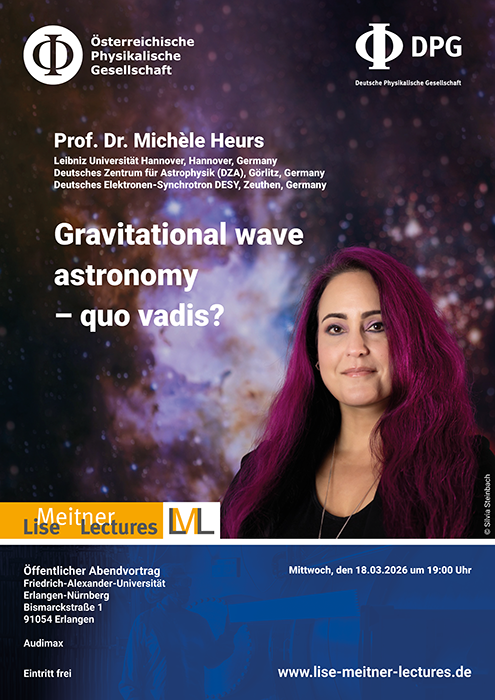
The sensitivity of current GW detectors is so incredible that the quantum noise of the employed ultra-stable laser light would be limiting. This necessitates the use of non-classical (“squeezed”) light, which is already routinely employed in the current (second) generation of detectors, e.g., aLIGO and AdVirgo. Many additional noise sources, such as seismic and thermal noise, pose further challenges for future (third-generation) detectors, e.g., the Einstein Telescope, a planned underground GW observatory in Europe.
To learn more about our Universe, we must achieve ever-higher detection rates for meaningful GW astronomy, which requires evergreater detection sensitivity and larger detection bandwidth. In my talk, I will introduce the principle of interferometric GW detection, highlight some of the advanced technologies (employed and under development), and shed light on the plans for future interferometric GW observatories.